


Often walking your dog at night isn't a choice. It's dark at five o'clock, the shift ran long, and the dog still needs to go out, so the walk happens. What changes after sunset is not your dog's comfort. It's who can see whom. Your dog can see the sidewalk fine. The problem is that drivers can’t see you and your dog as well as they could in daylight.
Night walking is mostly a visibility problem, but what you and your dog wear can go a long way to minimize it.
This will be a practical guide to how reflective gear works, what to put on your dog, what you should wear and carry as a responsible pet owner, plus a few habits to adopt for routes, crossings, and wildlife.
Is Night Time Dog Walking Safe?
It can be, if you plan for it. The risk that rises after dark is traffic, and it rises sharply.
NHTSA's Traffic Safety Facts, Pedestrians: 2023 Data reports that 77% of pedestrian fatalities in 2023 happened in the dark, compared with 19% in daylight. The same report counts 7,314 pedestrians killed in traffic crashes that year, which NHTSA puts at about 20 pedestrians a day.
That is not a reason to keep the dog inside. It's a reason to treat being seen as the main job of the walk. Drivers see what their headlights pick up, and dark clothing on you plus a dark dog beside you gives them little to pick up.
The other after-dark risks are smaller but real: footing and debris you can't see, loose dogs, and wildlife that is most active at dusk and after dark, all of which the tips section below covers.
Can Dogs See in the Dark? Your Dog's Night Vision vs Yours
Your dog sees movement in low light considerably better than you do.
The American Kennel Club credits rod-dominant retinas, where the human retina is cone-dominated, plus a structure called the tapetum lucidum. That is a layer of reflective cells behind the retina that acts like a mirror, giving the retina a second chance to register the light coming in. People don't have one.
AKC also points out that wild canines were primarily active at dusk and dawn, which is a fair explanation for why most dogs are so comfortable out after sundown.
No eye sees without light, including your dog's. Your dog can see the path. A driver still can't see a dog low to the ground, especially if it has darker fur. That's what the gear is for.
How Reflective Gear Works for Walking Dogs at Night
Reflective material bounces a vehicle's headlights back toward the driver. It does not make light of its own.
NHTSA puts it plainly in its pedestrian safety publication (DOT HS 811 559): reflective material on your clothing bounces the car's lights off you and back to the driver, which signals that something is moving ahead and they should slow down. We say the same about our own webbing at LupinePet®: our reflective designs reflect light, and they don't glow or light up.
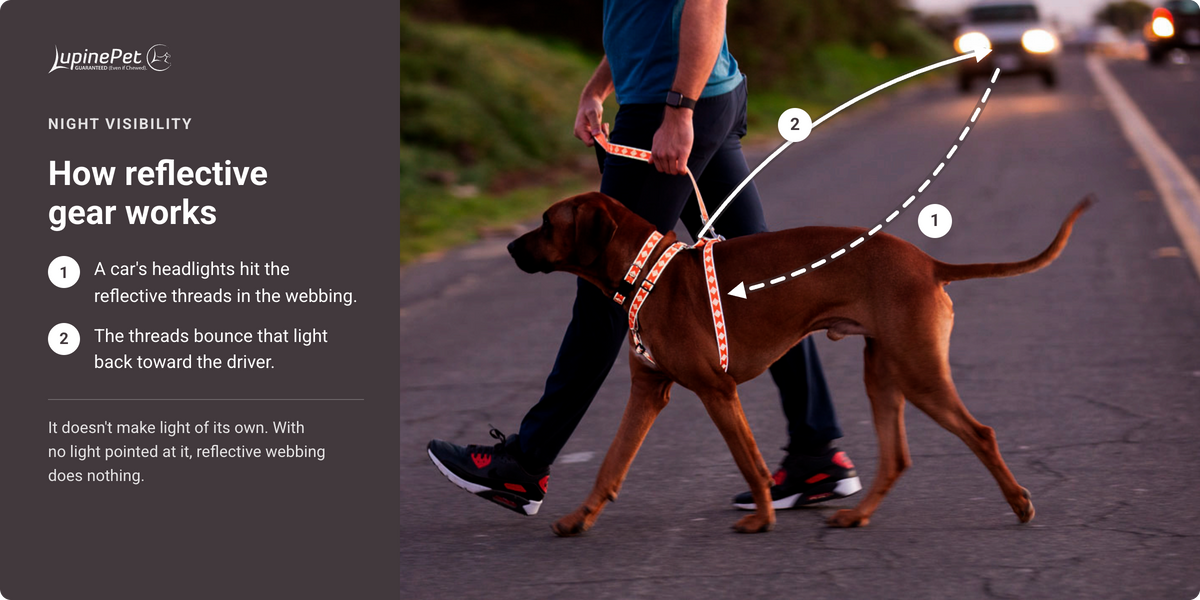
Reflective gear works for anyone with a headlight or a flashlight pointed your way. On an unlit path with no light source anywhere, it does nothing. Reflective webbing and a light you carry do two different jobs, and most night walks want both.
Our reflective designs pair bright, eye-catching colors with reflective threads woven directly into the design, made to shine in headlights and street lights. They come in six patterns: Blue Diamond, Blue Paws, Green Diamond, Orange Diamond, Pink Diamond, and Pink Paws.
What to Put on Your Dog for a Night Walk
A reflective collar or harness plus a reflective leash covers the dog. A light on you makes all of it work.
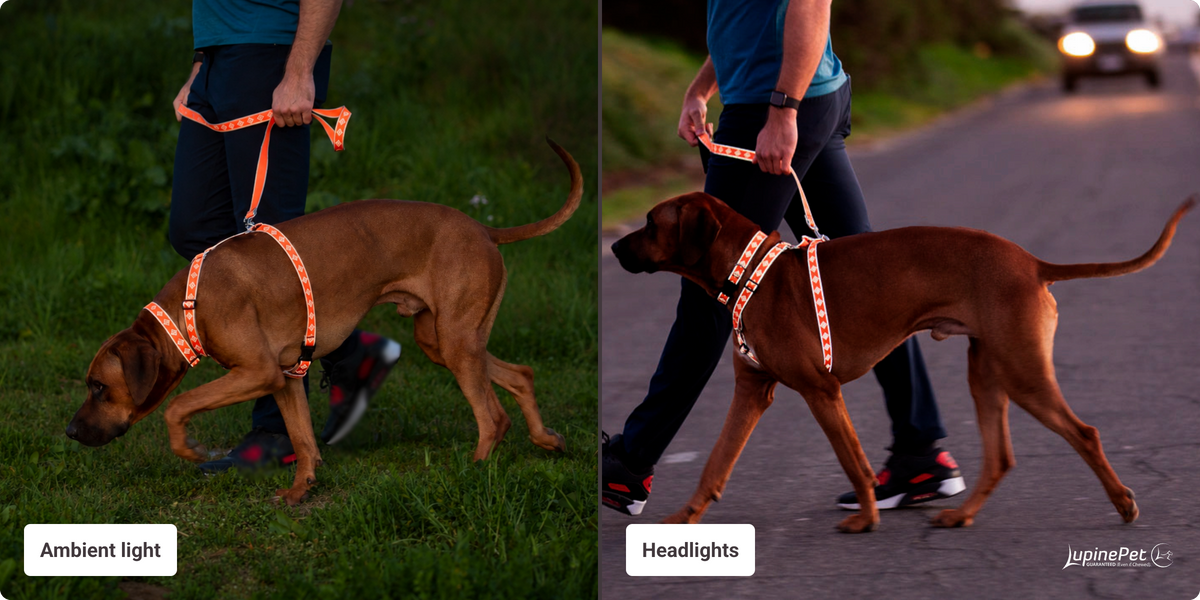
A black, dark brindle, or chocolate dog is much harder for a driver to spot at night. The reflective layer matters more for a dark dog, not less, which usually means putting reflective webbing at two heights rather than one.
Reflective collar (the baseline)
Your dog needs a reflective surface on by default, every walk, without anybody having to decide. That's the collar's job. The Reflective Dog Collar comes in reflective neon designs, in sizes from tiny to XXL, so the same gear works for a terrier and a shepherd.
While you're at it, an ID tag on that collar is the backup plan if a leash ever slips in the dark.
Reflective martingale collar (for dogs that back out)
A dog startled by a car, a deer, or a loose dog in the dark will often throw itself backward, and a flat collar can come off over the head. A martingale is a collar with a second, smaller loop that tightens a limited amount when the dog pulls, so the collar snugs up instead of sliding off.
With a proper fit, our martingale design prevents a dog from backing out. An additional D-ring gives ID tags a home, or you can clip to both D-rings and use the collar without the martingale action. The Reflective Martingale Collar comes in 3/4" and 1" widths for medium, large, and x-large dogs.
Martingale collars should not be left on an unattended dog, per our FAQs and Guides page.
Reflective harnesses (Roman, step-in, and no-pull)
A harness adds reflective webbing across more of your dog's body than a collar alone. The AKC notes that reflective stitching or material on a harness can be seen in low light.
The Reflective Roman Harness can be front clipped at the sternum o-ring, and dog trainers often recommend it for exactly that use, which is handy for a dog that pulls toward whatever it hears in the dark.
The Reflective Step-In Harness is the easiest on and off, which counts for something when you're getting out the door in the cold and the dark. Our own guidance: step-ins can be easy for some dogs to escape, and the Roman is the better pick for excitable dogs or pullers. At night that difference gets bigger, because a loose dog in the dark is much harder to find and recover.
The Reflective No-Pull Harness is made for medium and large dogs. It clips to your dog's everyday flat collar, and the leash attaches to the D-ring at the front of the chest. It is built for flat collars, not martingales, and it works best with a 2' or 4' leash. The collar and leash are sold separately. Dr. Amy Attas, VMD, quoted by the AKC, notes that no-pull harnesses are especially helpful for dogs larger than the person walking them. Control over a puller matters most when you're near traffic.
Reflective leashes, including the double handle
The leash adds a reflective line between you and your dog, and it's the piece you use to manage every crossing. The Reflective Dog Leash covers the standard case.
The Reflective Double Handle Leash is the one built for traffic. It comes in 3/4" and 1" widths, 4' or 6' long, with the usual padded handle at the top end plus a webbing traffic handle down at the snap end, so it is a long leash and a short one in the same piece. Grab the lower handle to bring your dog in close at a crossing, near traffic, or when you're passing another dog you can barely see. It is not offered for small dogs, since the traffic handle would sit out of reach.
Other reflective pieces worth knowing about
For specific handling needs, there is a short control handle in the Reflective Training Tab, the Reflective Slip Lead, and the Reflective Leash Coupler for walking two dogs on one leash.
Rufflect® Reflective Bandanas are a partner product made by Rufflect. They are reversible, with a solid cotton color on one side and silver reflective polyester on the other, and three snaps for adjustment. They are final sale and are not covered by our guarantee.
And for dogs already wearing hardware all day, reflective versions exist of the Underground Fence Collar, the E-Collar strap, and the Fi-compatible collar.
What the Walker Should Wear and Carry
Your dog's gear doesn't help much if the driver can't see you either. Light yourself too.
A headlamp or a handheld flashlight does two things at once: it shows you the footing, and it makes you more visible to vehicles. Clip-on lights are the same idea in a smaller package. Any of them beats walking in the dark, but headlamps are best to keep both hands free.
Wear something reflective or bright yourself. NHTSA's guidance for pedestrians is to be visible at all times, which after dark means reflective materials or a flashlight.
Carry a charged phone and poop bags you can find by feel.
Keep the phone in your pocket, not in your hand. The NHTSA tells pedestrians to stay alert and not be distracted by electronic devices that take your eyes and ears off the road, and that applies double when you're also managing a dog near a curb.
One more habit: tell somebody your route and when you expect to be back, especially for late or pre-dawn walks.
Night Dog Walking Tips: Routes, Leash Handling, and Wildlife
Choose lit, familiar routes, keep your dog on a short fixed-length leash, and know what to do if you meet wildlife.
Pick lit, familiar routes
NHTSA's advice for pedestrians is to walk on sidewalks whenever they are available, and where there is no sidewalk, to walk facing traffic and as far from it as possible. Where there is no crosswalk, NHTSA says to cross in a well-lit area with the best view of traffic. And never assume a driver sees you: make eye contact with drivers as they approach.
Familiar routes pay off after dark because you already know where the broken curb sits and which driveway is blind.
Short, fixed-length leash, not retractable
The AKC notes that a retractable leash only retracts when it is slack, so you can't reel a pulling dog back in. Longer leashes (20+ feet) are too long for most dogs; at that distance you can't supervise what your dog eats, fights with, or runs into before you can catch up. In the dark you want your dog within arm's reach at every crossing.
Coyotes and other wildlife
Humane World for Animals advises keeping dogs on a leash in public areas and never letting a dog interact or play with a coyote. If you meet one while walking your pet, do not run away. Stand your ground and firmly shout at the coyote till it leaves the area. If it retreats a short distance and stops to look at you, keep hazing. Humane World also notes that conflicts most often start when a loose dog chases a coyote, which makes the leash the main piece of equipment here.
The week the clocks change
The end of daylight saving time is when the evening walk suddenly happens in the dark without anything else about your day changing. Treat that week as the prompt to move the reflective gear into rotation.
Night Walk Checklist
- Reflective collar or harness on the dog, fit checked
- ID tag on and legible
- Reflective, fixed-length leash (not retractable)
- Light on you: headlamp, flashlight, or clip-on
- Something reflective or bright on you
- Phone charged, in a pocket
- Someone knows the route and the return time
- Route chosen for sidewalks and street lighting
FAQs About Walking a Dog at Night
Is it safe to walk a dog at night?
It can be, with reflective gear, a headlamp you wear, and a route you know. NHTSA reported that 77% of pedestrian fatalities in 2023 happened in the dark, so plan the walk around being seen. Most of that comes down to the gear and habits covered above.
What should my dog wear for a night walk?
A reflective collar or harness, a reflective leash, and an ID tag. A harness adds reflective webbing across more of the dog's body, which helps for dark-coated dogs. Pair all of it with a light (ideally a headlamp) on your person, so you both are more easily seen by oncoming traffic. A car's headlights will light up the reflective gear your dog wears if needed.
Is reflective gear or a light better?
Both, because they do different jobs. Reflective webbing bounces someone else's headlights back toward them. A light you carry shows your footing, warns people ahead of you, and gives the reflective webbing on your dog something to work with.
Can dogs see in the dark?
Better than people in low light. The American Kennel Club credits rod-dominant retinas and the tapetum lucidum, a reflective layer behind the retina that humans don't have. No eye sees without light, though, and a driver still can't see a dark dog low to the ground.
What time should I walk my dog at night?
Whatever time fits your dog's routine and your own. There's no single right hour. Adjust the gear and the route to the light you have, which means more reflective surface and a brighter carried light the darker it gets.
How do I keep a dark-coated dog visible?
Put reflective surface at chest height as well as neck height, so a reflective harness plus a reflective collar. Then keep a light on yourself, because the webbing only works when something shines at it. A reflective leash adds a line between you and the dog.
Final Thoughts
Your dog can see the path. The work left for you is making both of you visible to somebody behind a windshield, and that comes down to reflective webbing on the dog, a light on you, and a route you have chosen on purpose.
Every LupinePet-made piece in this article carries the GUARANTEED (Even if Chewed)® promise: a one-time replacement, free of charge apart from shipping, of LupinePet gear from your original purchase that's accidentally damaged during normal pet activity, including chewing. The guarantee page has the full terms.
Every piece is cut and sewn by hand by our team in one building in Conway, New Hampshire, where we've been making dog gear since 1991.
Sources Cited
- NHTSA, Traffic Safety Facts, Pedestrians: 2023 Data: https://crashstats.nhtsa.dot.gov/Api/Public/ViewPublication/813727
- NHTSA, Everyone Is a Pedestrian: https://www.nhtsa.gov/document/everyone-pedestrian
- NHTSA pedestrian safety publication (DOT HS 811 559): https://www.nhtsa.gov/staticfiles/nti/pdf/811559.pdf
- American Kennel Club, Can Dogs See in the Dark?: https://www.akc.org/expert-advice/lifestyle/can-dogs-see-in-the-dark/
- American Kennel Club, Retractable Dog Leashes: When and How to Use Them Safely: https://www.akc.org/expert-advice/training/retractable-dog-leashes-use-safely/
- American Kennel Club, Choosing the Right Harness for Your Dog: https://www.akc.org/expert-advice/lifestyle/choosing-the-right-dog-harness/
- Humane World for Animals, What to do about coyotes: https://www.humaneworld.org/en/resources/what-do-about-coyotes
- LupinePet, Reflective Dog Collar: https://www.lupinepet.com/products/reflective-dog-collar
- LupinePet, Martingale Collar, Reflective Designs: https://www.lupinepet.com/products/martingale-collar-reflective-designs
- LupinePet, Reflective Roman Harness: https://www.lupinepet.com/products/reflective-roman-harness
- LupinePet, Reflective Step-In Harness: https://www.lupinepet.com/products/reflective-step-in-harness
- LupinePet, Original Designs Step-In Dog Harness (harness selection guidance): https://www.lupinepet.com/products/original-designs-step-in-dog-harness
- LupinePet, Reflective No-Pull Harness: https://www.lupinepet.com/products/reflective-no-pull-harness
- LupinePet, Reflective Double Handle Leash: https://www.lupinepet.com/products/reflective-double-handle-leash
- LupinePet, FAQs and Guides: https://www.lupinepet.com/pages/faqs-guides
- LupinePet, GUARANTEED (Even if Chewed)®: https://www.lupinepet.com/pages/lupine-guarantee
